



Added: Nov 13, 2024
Last edited: Mar 19, 2025
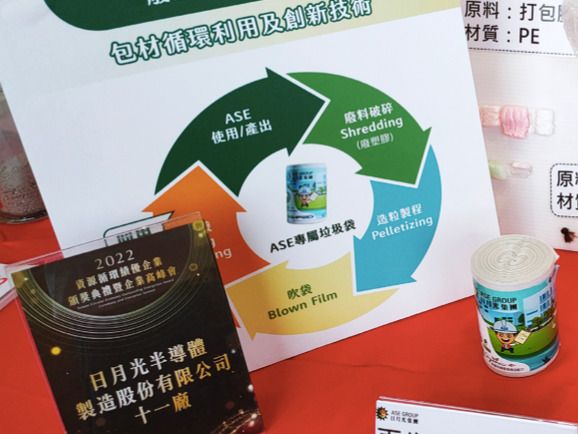
A plastic recycling center has been established at ASE’s Kaohsiung plant to centrally classify and process waste plastics collected from different plant areas, providing downstream processing operators with the opportunity to turn the waste into plastic pellets, garbage bags and solid renewable fuel, so that the waste can be commercialized.
In July 2022, ASE established a plastic recycling center at its Kaohsiung plant to centrally manage and classify waste plastics collected from throughout the plant. This allows waste plastics that were originally misclassified or are difficult to process because of their composite materials to be correctly sorted, eliminating the risk of being unable to recycle mixed plastic materials or reusable plastics being randomly discarded.
Overcoming regulatory challenges
In the past, plastic waste came from different plant areas, and centralized removal and classification management was difficult due to regulatory restrictions. ASE established a plastic recycling center and coordinated with the Ministry of Environment, Environmental Protection Bureau and Management Office to ensure that operations such as classification and cutting were carried out without changing the composition and nature of the waste, and finally obtained relevant government permits.
Hierarchical use of waste plastics
The Plastic Recycling Center first converts waste plastic into plastic pellets based on material. In cooperation with value chain partners, a portion of the pellets is reproduced into garbage bags, while the rest is provided to downstream manufacturers for use as raw materials. Finally, the remaining materials are made into solid renewable fuel (SRF) and used as raw materials for power generation.
Establishing supplier packaging material specifications
To improve the use of packaging materials from the source, ASE communicated and coordinated with suppliers on multiple occasions to confirm the materials of various waste plastics and the basis for judgment, and conducted education and training for workers to standardize classification operations. This not only increases the resource utilization ratio of waste plastics, but also ensures product consistency and service quality.
▪ In 2023, recycling plastic waste reduced carbon emissions by approximately 68 metric tons of CO2e [1].
[1] The collected waste plastics are recycled into garbage bags, plastic pellets, solid renewable fuels, etc. and provided to downstream manufacturers as raw materials.