


Approved by curator


Added: Sep 17, 2021
Last edited: Sep 29, 2021
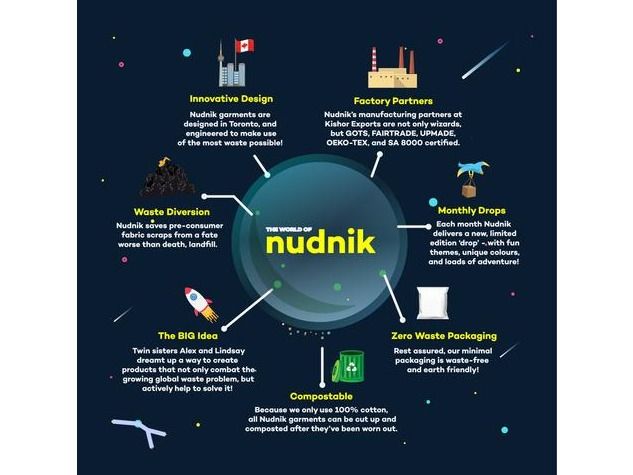
Most garment and fabric pieces go through a linear lifecycle. One type of waste is pre-consumer textile waste. Pre-consumer textile waste poses a major concern: raw materials that goes into the production of the textile were extracted for nothing, not to mention the possibilities of any negative externalities that go along during the production stages. Nudnik works with cutting waste as a form of pre-consumer textile waste to make its kids wear collection. It collects the 'wasted' small scraps and works with its manufacturing partners which are GOTS, FAIR TRADE, UPMADE, OEKO-TEX and SA-8000 certified. This helps to minimise any pre-consumer cutting waste going to the landfill, and promote environmental and social justice at the same time.
The conventional fashion industry is one of the most wasteful industries in many different ways: It can take 2700 litres of water to produce one t-shirt, and toxic chemicals and dyes used in garment production and discharged into waterways can hamper aquatic ecosystems. Meanwhile, most garment and fabric pieces go through a linear lifecycle. They are produced... and eventually sent to the landfill or incinerator upon disposal. One type of waste in the fashion industry is pre-consumer textile waste. These are waste material produced before the textile pieces even reach the consumer. It includes for example fabric leftover after cutting out a pattern, those resulted from overstocking, defective printing, dying and finishing. In fact, as a result of the natural shapes that make up a garment, approximately 10-30% of the fabric is cut away and discarded during the cutting process, destined for landfill or incineration. Accounting for the amount of cutting waste, there is enough cutting waste produced by the industry each year to produce 6 new t-shirts for each individual on the planet.
Nudnik works specifically with pre-consumer textile waste in the form of 'cutting waste' or 'off/cut fabrics' to make its kids wear collection. Its collection is designed to utilise these small scraps as much as possible in Toronto. After designing, it is produced by its manufacturing partners at Kishor Exports which are GOTS, FAIR TRADE, UPMADE, OEKO-TEX and SA-8000 certified.
According to Nudnik, with its collection of kids wear, it has avoided more than 4427 km of driving emissions, saved 245,083 days of drinking water, 684,622 hours of LED bulb energy, and diverted 1157 pounds of waste from the landfills. These figures are updated on a regular basis as Nudnik continues to reduces the carbon footprint that would have been otherwise needed to produce new material. Meanwhile, the impacts on individual garment pieces are also provided on its webpage.
Choosing its manufacturing partners also bring several advantages. Those who are GOTS certified ensures high-level environmental criteria along the entire organic textiles supply chain and requires compliance with social criteria. FAIR TRADE helps to ensure the best prices are provided to farmers. UPMADE enables and audits the manufacturing partner to apply its industrial upcycling method. OEKO-TEX certifications assures that the products do not contain chemicals or other dangerous substances that are unfavourable to human health. Lastly, the SA-8000 certification ensures decent working conditions.
Nudnik also uses zero waste packaging and their packaging and garments pieces are also fully compostable.
design out waste
pre-consumer waste