


Added: Dec 17, 2020
Last edited: Jan 28, 2021
Abstract
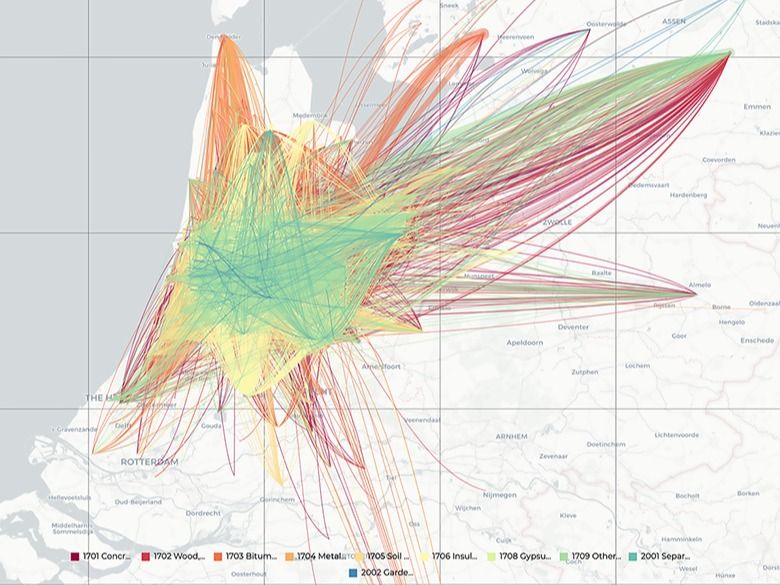
Fundamental changes in the societal use of biophysical resources are required for a sustainable transformation. Current (urban) metabolism research traces flows of energy and materials to capture resource use along value chains from resource extraction to production and consumption and the discharge of wastes and emissions. However, spatial relation, local carrying capacity and qualitative characteristics of the urban landscape are only featured in very few studies. Simultaneously, spatial studies tend to neglect the dimension of processes of flows and the generated stocks that influence the construction and performance of space. Big data and GIS technologies have the potential to leverage the integration between the two fields of knowledge. Therefore, the article explores the development of an innovative method - Activity-based Spatial Material Flow Analysis (AS-MFA) - that integrates qualitative and quantitative flow specifications in material content and geographical space, starting from the analysis of waste flows relative to the Amsterdam Metropolitan Area (NL). Lastly, the article reflects on the results of the application of the AS-MFA method, namely a series of flow maps. Each flow map is a significant data-based network representation of a part of the urban metabolism within the AMA in a specific period of time.
Until today, Material Flow Analysis is one of the most common methods in the Urban Metabolism framework. The advantages of the current UM framework can be summarised as follows:
-Identification of system boundaries
-Identification and classification of flows
-Calculation of system inputs and outputs
-Study of specific urban sectors concerning sustainability goals
-Identification of adaptive approaches to solutions and their consequences
-Integration of social dynamics with biophysical sciences/technology
However, the current UM method includes some limitations :
-Extensive data collection and resource requirements
-Lack of data for specific territories
-Lack of spatialisation of data
-The necessity to process a considerable amount of data
-Difficulties in identifying cause-and-effect relationships of the metabolic flows
This scientific article explains a refined Urban Metabolism approach developed by REPAIR Project. This innovative approach aims to analysis material flows in which address more explicitly spatial impacts. Firstly, the article explains the role and the use of big data in the elaboration of a refined flow mapping. Secondly, it describes the innovative methodology called Activity-based Spatial Material Flow Analysis and the test of the latter on the Amsterdam Metropolitan Area (AMA). Lastly, the paper discusses the limitations and benefits of the method, starting from the results of the case study.
Detailed data on material flows concerning urban territories is, by definition, big data - not only because of the extensive amounts of flows but also because of the complexity of the flow networks. This paper has explored Constructions & Demolition material flows, after becoming waste, by focusing on the AMA across five years. The proposed AS-MFA method allows constructing a digital model of flows on given space and juxtaposing with spatial components, such as infrastructural networks and landscape systems. Moreover, this method helps to reduce the complexity of interpreting big data, by selecting: territorial portions, temporal extent, economic activities and materials of interest. Lastly, the AS-MFA permits to explore each type of data separately from the system, and it works well with a single homogenous dataset. However, nowadays, it only includes waste materials.