



Added: Jan 03, 2023
Last edited: Jan 17, 2025
When the landfilling site of Akreuch, that used to treat the waste generated in the Rabat agglomeration was closed down and replaced by the new sanitary landfill of Oum Azza, a cooperative was created to secure the activity and improve the working conditions of about 150 informal workers who were scavenging waste in Arkeuch.
Formalization of waste management is pivotal in guaranteeing effective and sustainable waste recovery, however, if conducted without care, it risks leaving thousands of informal workers without a mean of livelihood. This was a risk when the landfilling site of Akreuch was replaced by the new sanitary landfill of Oum Azza, as 150 informal workers who were scavenging waste in Arkeuch risked losing their jobs.
The creation of the cooperative was part of the new agreement signed between the 13 communes of the Rabat agglomeration and the waste operator of the new landfill, Teodem. The practical organisation was commissioned by Teodem to an international NGO, CARE. The cooperative relies on the collaboration of diverse local stakeholders: the international NGO, CARE; the operator of the Oum azza site, Teodem; the 13 communes of the region (including Rabat, Salé, Témara and Skhirate), the ministerial department in charge of the environment, the Office of Development and Cooperation and the informal reclaimers.
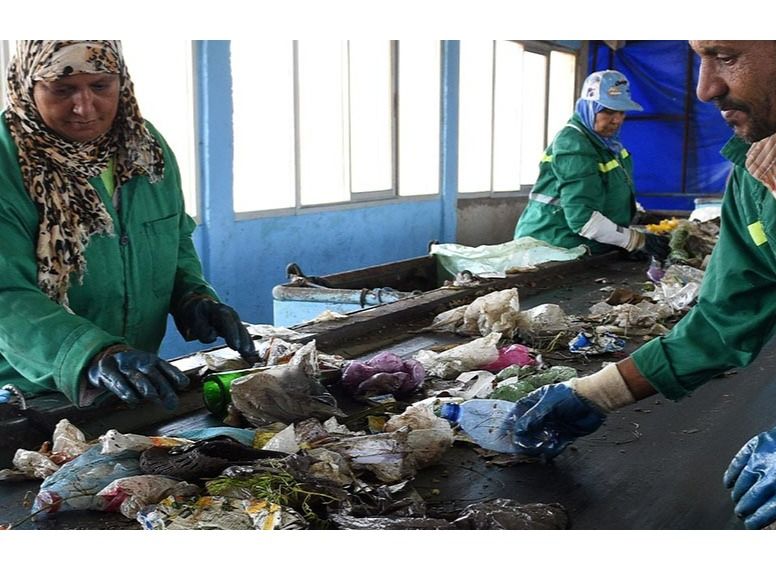
The cooperative, called Attawafouk, manages a sorting platform and sells the sorted materials (plastic, glass, and metal) to recyclers. In 2016 the centre capacity was doubled from 400 tonnes/day to 1,000 tonnes/day. The cooperative has integrated about 200 waste sorters, including 27 women. The project led to the creation of the job of “sorting operator”, which gives a social status to the previously informal workers. Besides waste sorting, the cooperative is also involved in awareness raising activities and participates in communication campaigns and events targeting the general public.
The ATTAWAFOUK cooperative manages to extract more than 5,000 tonnes of recoverable materials each year: about 1,800 tonnes of plastic per year, including 1,320 tonnes of PET, about 500 tonnes of metal packaging (including 300 tonnes of steel cans and 60 tonnes of aluminium cans), 1,200 tonnes of cardboard and 500 tonnes of paper. Each year, 80,000 tonnes of green waste are turned into compost and sold as fertilizers to farmers. These different sorted quantities lead to a decrease in landfilling.
switch2ceplastics